THE ECONOMICS OF NOTHING: WHY ANTIMATTER IS THE MOST EXPENSIVE SUBSTANCE AND WHY THAT WILL CHANGE
CERN produces approximately 10 nanograms of antiprotons per year. The fully-loaded cost is roughly $10 trillion per gram — a number so large it loses meaning on contact. All the gold ever mined is worth about $10 trillion. To produce one gram at current rates would require the entire global particle physics infrastructure for approximately ten million years.
This is the number that gets cited. What almost never gets cited is the reason for it, because the reason changes everything. The cost is not physics-limited. It is manufacturing-limited. The underlying energy cost of pair production is on the order of 2 GeV per antiproton — about 3.2 × 10⁻¹⁰ joules per particle. A gram of antiprotons contains roughly 6 × 10²³ of them. At industrial electricity prices, the thermodynamic floor for antimatter production is between $1 billion and $10 billion per gram. The gap between what physics requires and what CERN spends is not a law of nature. It is a yield problem.
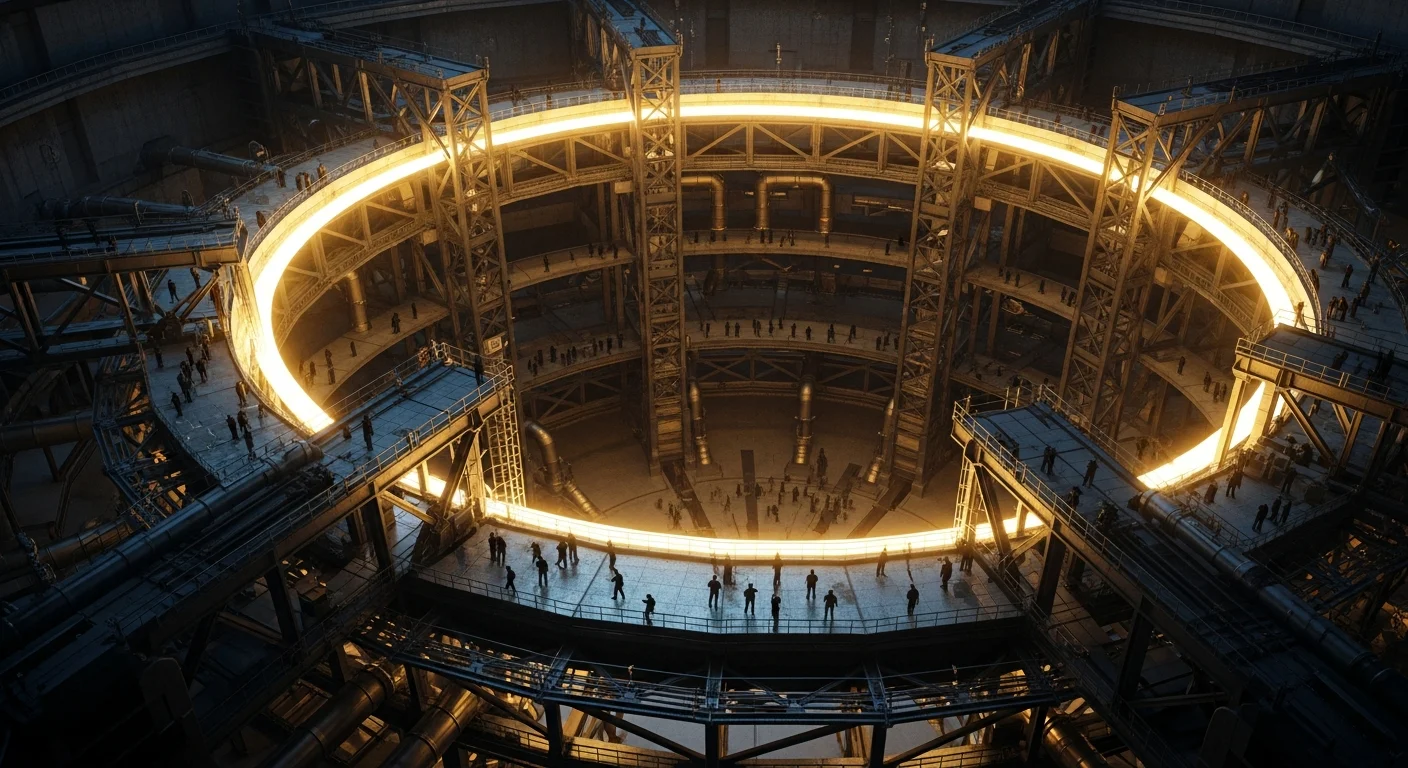
Current production is batch-mode, loss-dominated, and optimized for physics experiments rather than yield. The Halo Accelerator architecture addresses this at the system level. Continuous production replaces batch cycles. Magnetic geometries optimized for capture rather than experimental access improve collection efficiency by orders of magnitude. Closed-loop cooling recycles deceleration energy. At projected scale, these improvements compound exponentially. The path from trillions per gram to billions per gram is a manufacturing problem.
The market implications are significant. At billions per gram, positron emission tomography isotope production becomes a commodity. At millions per gram, space propulsion becomes an engineering problem rather than a financial impossibility. The most expensive substance in the world is expensive because no one has built the right factory yet.